





RWE McLaren 720S / 750S / 765LT Stainless High-Flow Downpipes
Heat Shielding
Optionen wählen
Heat Shielding
Heat Shielding
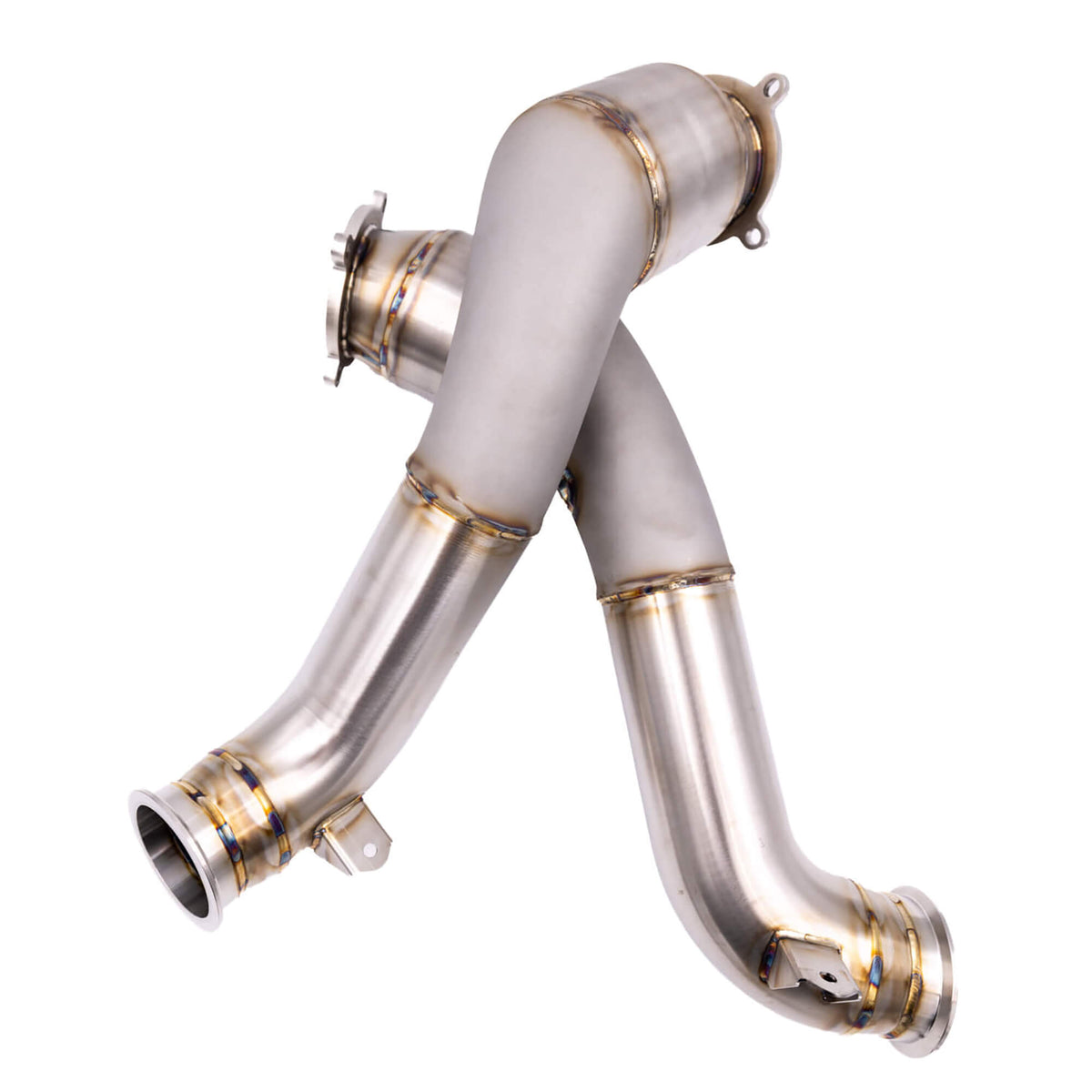
RWE Catted High Flow Downpipes for McLaren 720S / 750S / 765LT
The factory McLaren 7XX downpipes do a lot of things well, but they are still constrained by emissions, packaging and mass-production requirements. Our RWE Catted High Flow Downpipes were developed to reduce restriction, improve exhaust flow and retain a direct-fit installation without giving up the refinement of a catalytic converter.
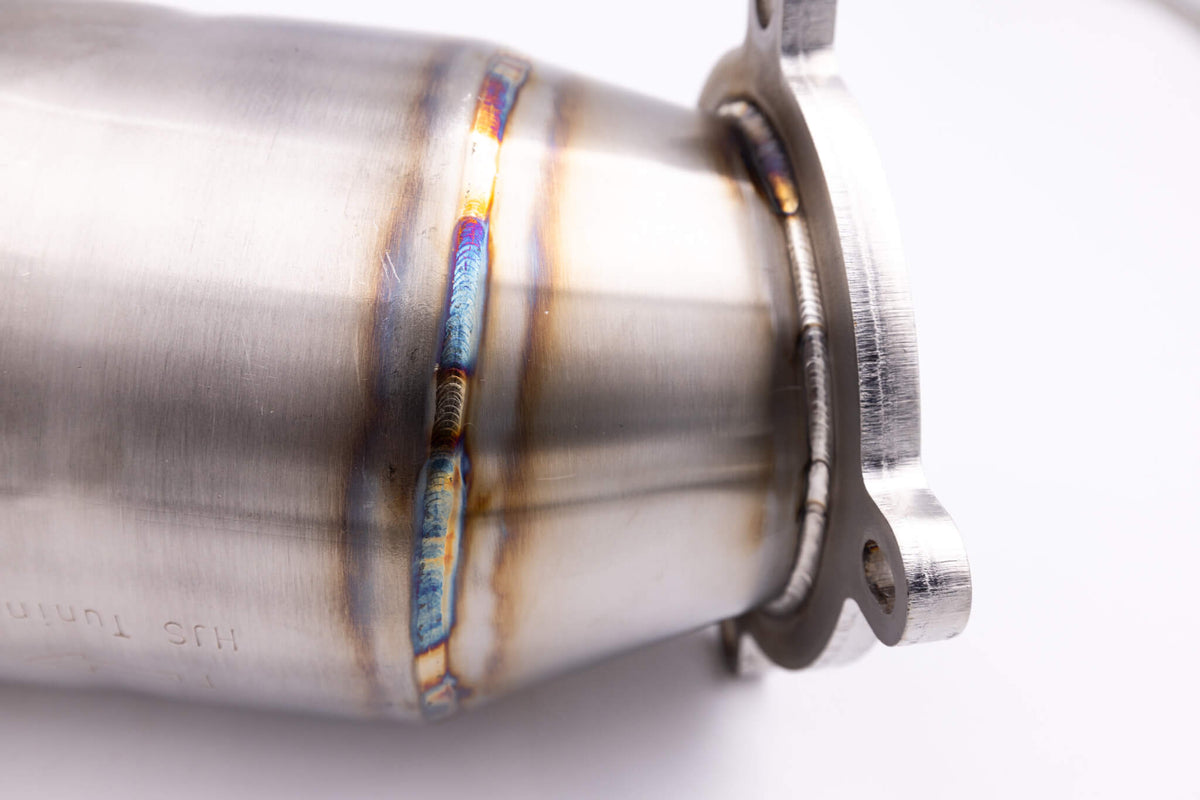
Built from stainless steel around premium HJS 200 cell metallic catalysts, these downpipes replace the factory assemblies with a substantially freer-flowing system designed specifically for the 720S, 750S and 765LT platform. The post-catalyst section is produced using metal 3D printing, allowing us to create internal geometry that would be extremely difficult, or impossible, to reproduce with conventional cut-and-weld fabrication.
Designed around flow, not just pipe diameter
Reducing exhaust restriction is not simply a matter of making the tubing larger. On a turbocharged engine, the shape, area changes and transitions immediately after the turbine and catalyst all affect pressure drop, turbulence and how efficiently exhaust energy can leave the system.
The RWE downpipe is designed to manage those transitions as smoothly as possible. Instead of forcing exhaust gas through abrupt changes in cross-section or multiple welded sections, the 3D-printed post-cat section allows the internal passage to be shaped as a continuous flow path.
This gives us much more control over the geometry than traditional fabrication methods and allows the system to transition from the catalyst outlet into the downstream exhaust with less disruption to the exhaust stream.
3D-printed post-cat section
The most unique part of this system is the 3D-printed section immediately downstream of the catalyst. Additive manufacturing lets us design the internal shape around airflow first, rather than designing around what can physically be formed from mandrel bends and welded tubing.
- Smoother internal transitions between changing cross-sectional areas
- Reduced dependence on abrupt welded junctions
- Greater control over internal flow path and outlet geometry
- More freedom to work within the extremely tight packaging of the McLaren rear chassis
- Consistent geometry from part to part
- Allows the external shape and internal passage to be optimized independently where packaging requires it
That matters on the 7XX platform because there is very little wasted space between the turbochargers, catalyst assemblies, heat shielding and rear exhaust. The best flow path is not always the simplest shape to fabricate conventionally.
HJS 200 cell high-flow catalysts
We chose HJS catalysts for a reason. HJS is one of the benchmark manufacturers in high-performance and motorsport catalyst technology, with its tuning catalysts developed directly from the company's motorsport programs. Their 200 cell metallic catalyst architecture is designed specifically for applications where exhaust flow, heat resistance and catalyst durability all matter.
HJS designs its high-flow catalysts to reduce backpressure while maintaining an effective catalyst structure, rather than simply removing substrate density and accepting the compromises that come with a cheaper race cat. The result is a catalyst that can move a large amount of exhaust mass while still surviving the kind of sustained temperature and vibration these cars generate.
The HJS core is also a major reason we were able to build a system that performs this well without creating the usual drivability compromises associated with many aftermarket downpipes. In our testing on the McLaren 7XX platform, we have not observed a check engine light on the factory ECU calibration, with no tune or map changes required simply to install and operate the downpipes.
For us, that balance is important. Maximum flow is easy if you remove the catalyst entirely. Building a catted system that flows extremely well, survives repeated track use and behaves properly on the car is a much harder problem. That is where the HJS catalyst earns its place in this system.
Developed and proven under real track conditions
These downpipes were not developed as a show piece or dyno-only part. They have been thoroughly tested in the same high-load environments we build these cars for, including sustained track use where exhaust temperature, heat soak and repeated thermal cycling are far more demanding than normal street driving.
That testing is especially important with a catted turbo system. The catalyst, surrounding tubing and nearby components are all exposed to tremendous heat during extended sessions, so the entire assembly has to work as a system. Our development focused on flow, catalyst durability, thermal control and long-term reliability rather than simply maximizing peak output for a short dyno pull.
- Tested under sustained high-load track use
- Validated through repeated thermal cycling
- HJS 200 cell metallic high-flow catalysts
- Motorsport-derived catalyst technology
- Designed for reduced backpressure and high exhaust mass flow
- No CEL observed in RWE testing on the factory ECU calibration
- No ECU tune required for basic operation
- Designed around the extreme heat generated by the M840T platform
- Built for serious street, HPDE and dedicated track use
Thermal management options
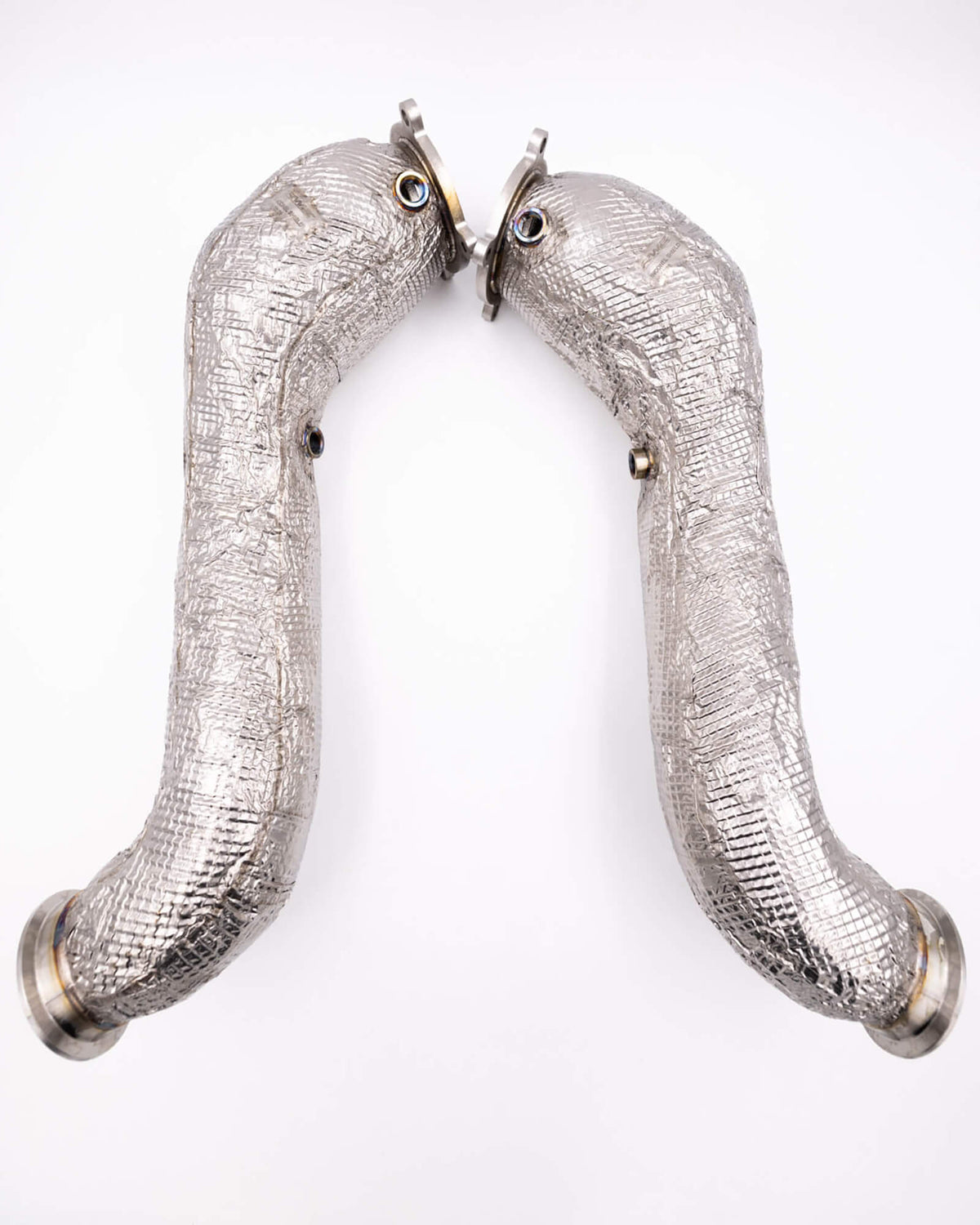
The downpipes sit in an extremely heat-dense area of the McLaren rear chassis, so thermal management is an important part of the package. We offer multiple heat-protection options depending on how aggressively the car is used and how much thermal isolation the build requires.
- Standard Heat Wrap: Conventional high-temperature fabric exhaust wrap, similar to the DEI-style materials commonly used in motorsport and performance applications. This is a cost-effective way to reduce radiant heat from the downpipes and help manage temperatures around surrounding components.
- Premium Inconel Heat Wrap: Our highest-level thermal protection option for cars that see sustained track use, higher power levels or simply need the best possible heat management. Inconel shielding is designed to tolerate extreme exhaust temperatures while providing significantly more robust thermal protection in the harshest environments.
For dedicated track cars or higher-output builds, we strongly recommend the premium Inconel option. Keeping radiant heat under control helps protect nearby wiring, body panels, intake components and other heat-sensitive systems while reducing the amount of heat retained in the surrounding engine bay.
Built for the McLaren M840T platform
The 720S, 750S and 765LT all use McLaren's 4.0L twin-turbo M840T architecture, and exhaust flow becomes increasingly important as power output rises. Higher boost, increased airflow and more aggressive calibration all increase the amount of exhaust mass that has to move through the turbine outlet and downpipe assembly.
Reducing unnecessary restriction in this area gives the system more headroom, whether the car remains close to stock or is developed further with ECU tuning, intake changes or other supporting modifications.
Works without a tune, benefits from one
The downpipes are designed to function correctly on the factory ECU calibration, and in our testing we have not observed a check engine light simply from installing the hardware. That makes them a straightforward upgrade for customers who want to improve exhaust flow without immediately changing the calibration.
For customers looking to take full advantage of the additional flow, we recommend pairing the downpipes with an appropriate ECU calibration. A tune can optimize boost, fueling and ignition around the reduced exhaust restriction and supporting hardware, allowing the engine to make better use of the upgrade.
Our preferred pairing is the M-Engineering ECU Calibration for the McLaren 720S / 750S / 765LT platform, which gives you the calibration flexibility to properly support the downpipes and the rest of the vehicle's hardware.
Direct OEM-style fitment
Performance hardware is only useful if it fits correctly. These downpipes were designed as a true direct-fit replacement for the factory assemblies, using the original mounting locations and downstream exhaust interface.
- Direct replacement for the OEM downpipes
- No cutting or permanent vehicle modification required
- Works with the factory McLaren exhaust system
- Compatible with aftermarket exhaust systems that retain the OEM downpipe connection location
- Designed around factory-style mounting and packaging
This means you can upgrade the downpipes independently without being forced into a complete exhaust system at the same time.
Stainless steel construction
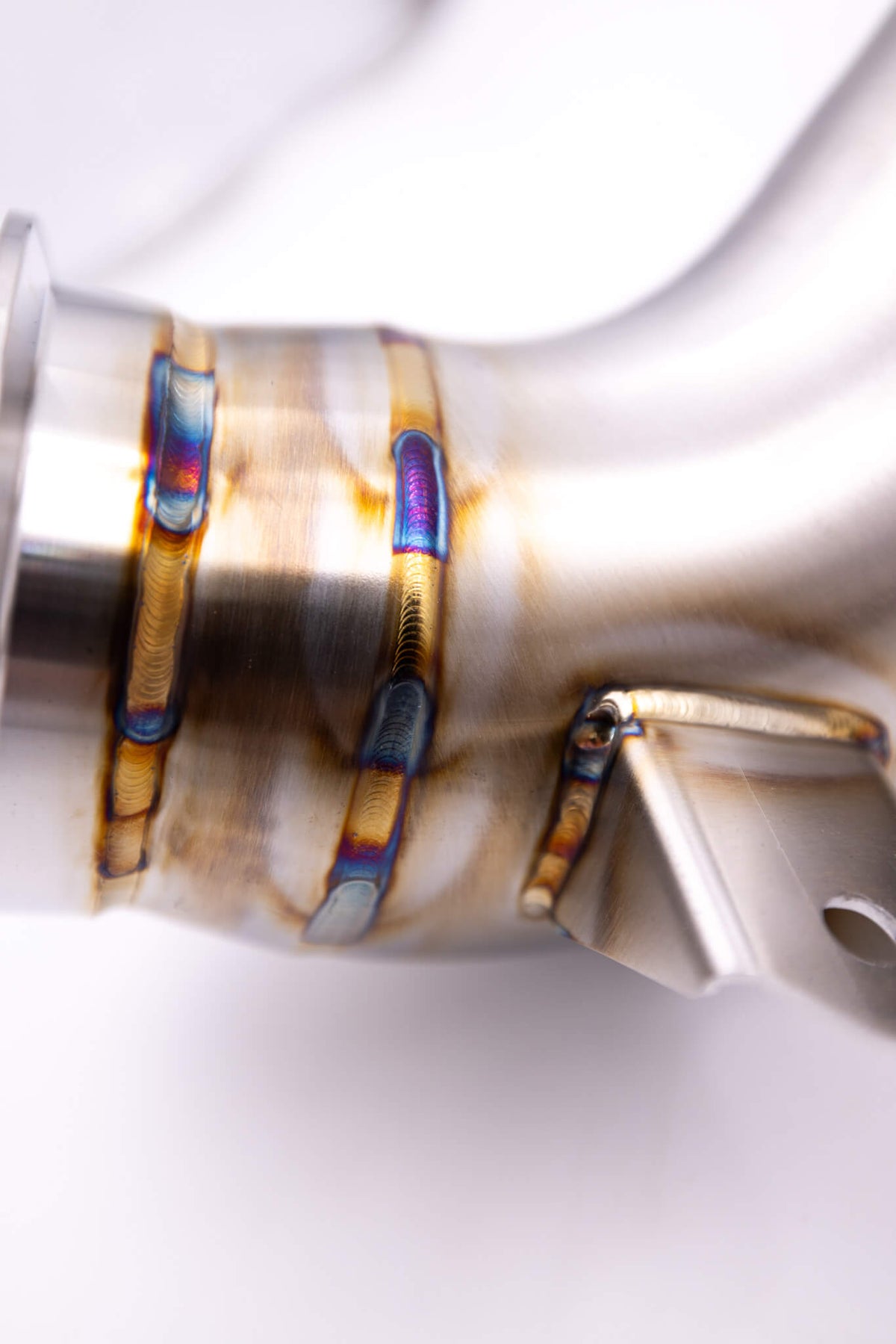
The fabricated portions of the downpipes are constructed from stainless steel for durability in the extreme thermal environment directly downstream of the turbochargers. This area of the exhaust sees repeated heat cycling, high exhaust gas temperatures and substantial expansion and contraction, especially on cars that see sustained track use.
The material and construction method were chosen around long-term performance in that environment, not simply appearance.
More sound without abandoning the catalyst
Reducing restriction upstream of the muffler also changes the character of the exhaust. Compared with the factory downpipes, the high-flow HJS catalysts allow more of the M840T's natural exhaust note to reach the rear system, giving the car a sharper and more aggressive sound while retaining catalytic converters.
The final sound level will depend heavily on whether the car is using the factory exhaust or an aftermarket rear section.
Designed to work as a complete system
We developed these downpipes around the way the entire exhaust system works, from the turbine outlet through the catalyst and into the rear exhaust. The HJS 200 cell catalyst reduces restriction, the 3D-printed transition manages the exhaust path after the catalyst, and the direct-fit outlet allows the system to integrate cleanly with the rest of the car.
The goal was not simply to make another set of aftermarket downpipes. It was to build a better-flowing, more thermally controlled version of the factory component without compromising fitment, catalyst quality or day-to-day usability.
Fitment
- McLaren 720S
- McLaren 720S Spider
- McLaren 750S
- McLaren 750S Spider
- McLaren 765LT
- McLaren 765LT Spider
Key features
- RWE-developed high-flow downpipe system
- Stainless steel construction
- HJS 200 cell metallic high-flow catalytic converters
- HJS motorsport-derived catalyst technology
- Designed for reduced backpressure and high exhaust mass flow
- 3D-printed post-catalyst flow section
- Optimized internal transitions and exhaust path
- Direct OEM-style fitment
- Compatible with the factory McLaren exhaust
- No permanent vehicle modification required
- No CEL observed in RWE testing on the factory calibration
- No tune required for basic operation
- M-Engineering ECU tuning recommended for maximum performance
- Thoroughly tested under sustained track use and high thermal load
- Available with standard fabric heat wrap or premium Inconel thermal protection
- Designed for McLaren 720S, 750S and 765LT applications
RWE engineered for the 7XX platform
We work with these cars in both street and track environments, so the priorities are straightforward: the part has to flow properly, survive the heat, fit like it belongs on the car and integrate with the rest of the system without creating unnecessary problems. The RWE 7XX Catted High Flow Downpipes were developed around those requirements and proven in the environments where those details matter most.

Full Service Available
RWE Motorsport is a top tier championship-winning race shop located in Southern California with a history of building high performing, reliable vehicles since 2011.
We pride ourselves on our commitment to delivering only the best performing, highest quality parts that are track and race proven.
A full line of services are available for your vehicle from installations to motorsport level racing builds.